
An Interview with Open Portrait Photographer of the Year - Ellen Reus
Nov 23, 2025
Ellen Reus is a pet and animal photographer based in the Netherlands, working under the name Wolves Fotografie. Her striking portfolio of three images of snakes won the 2025 Open Portrait Category at the International Pet Photography Awards, and remarkably, it was her first time entering.
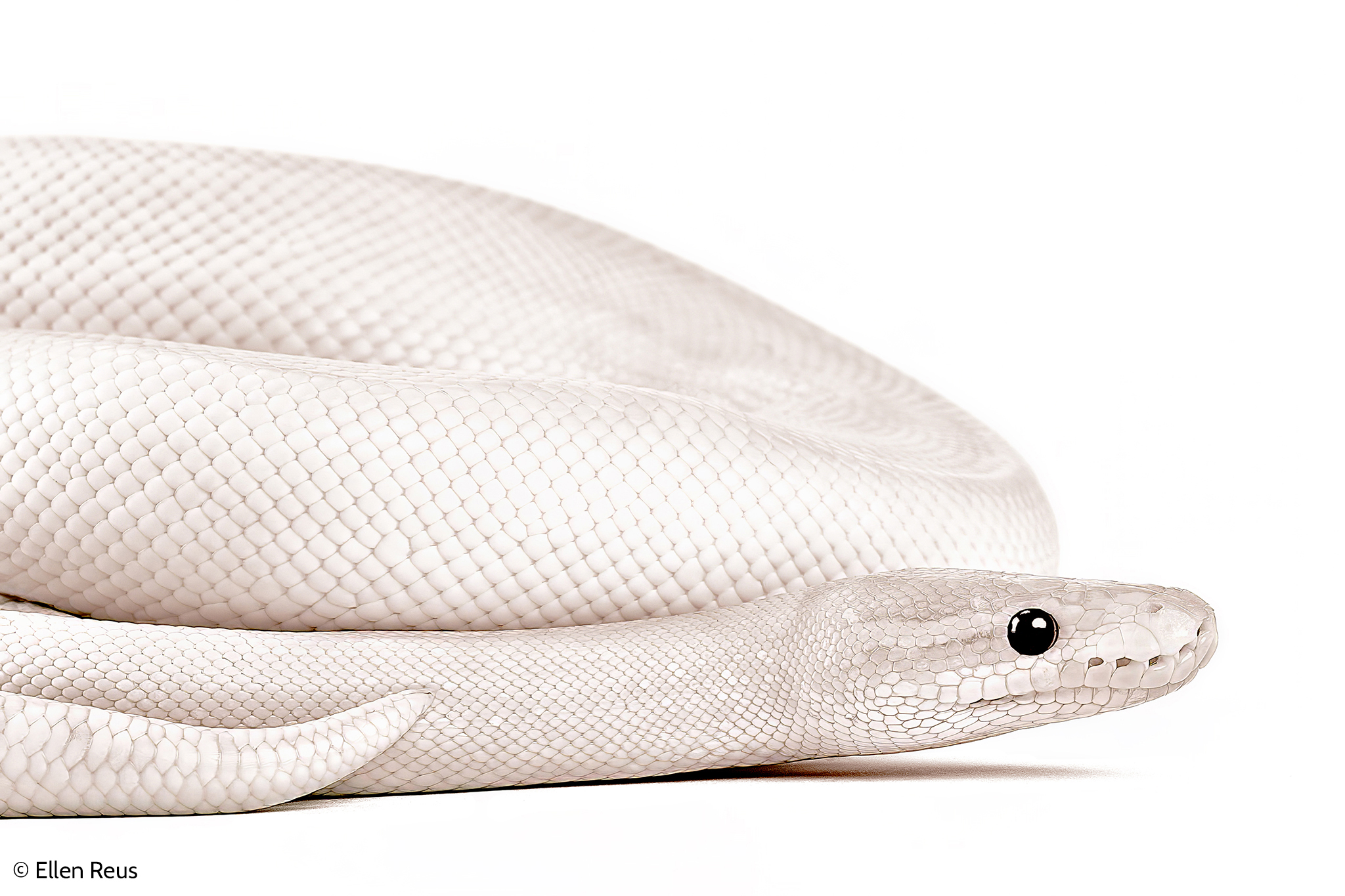
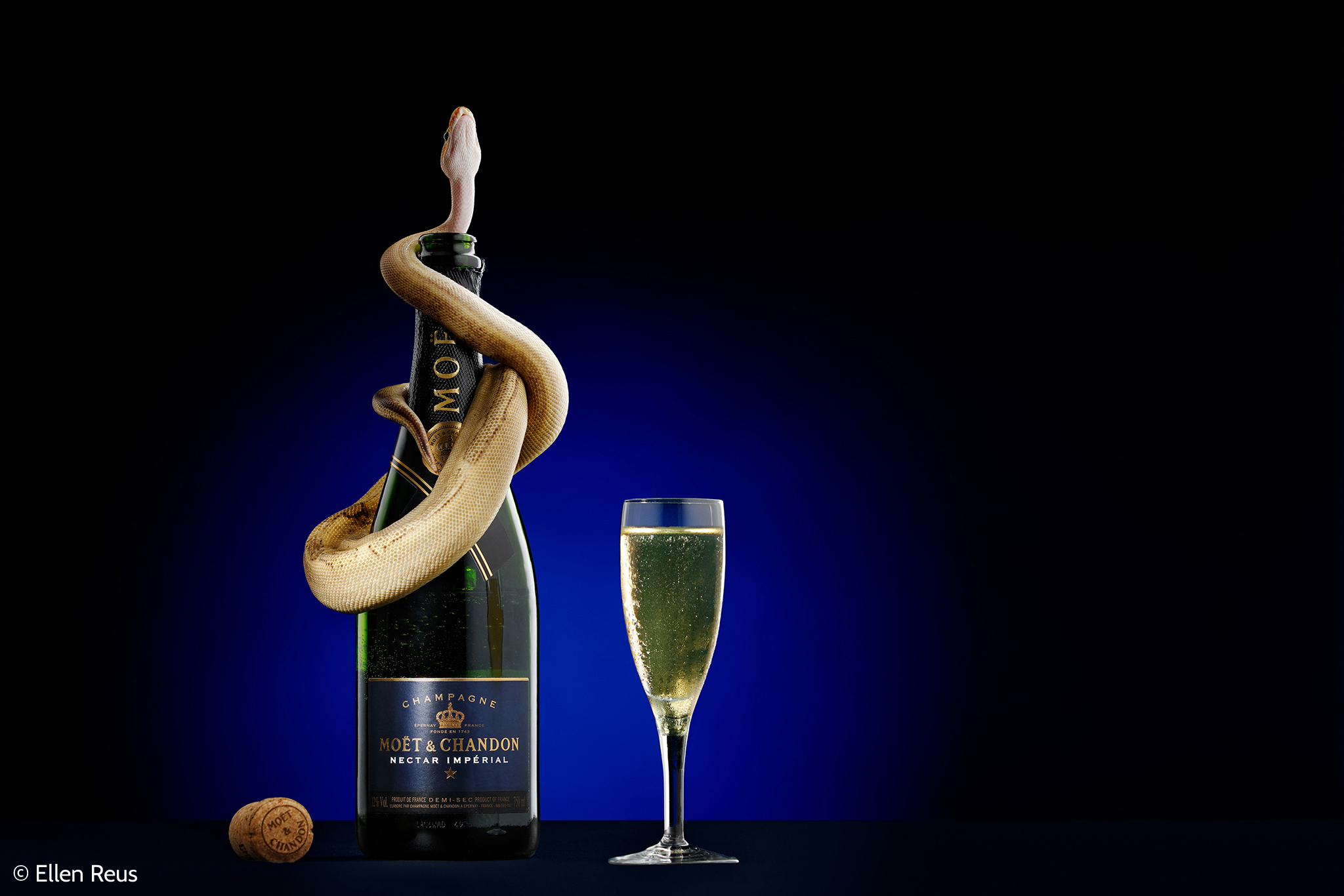
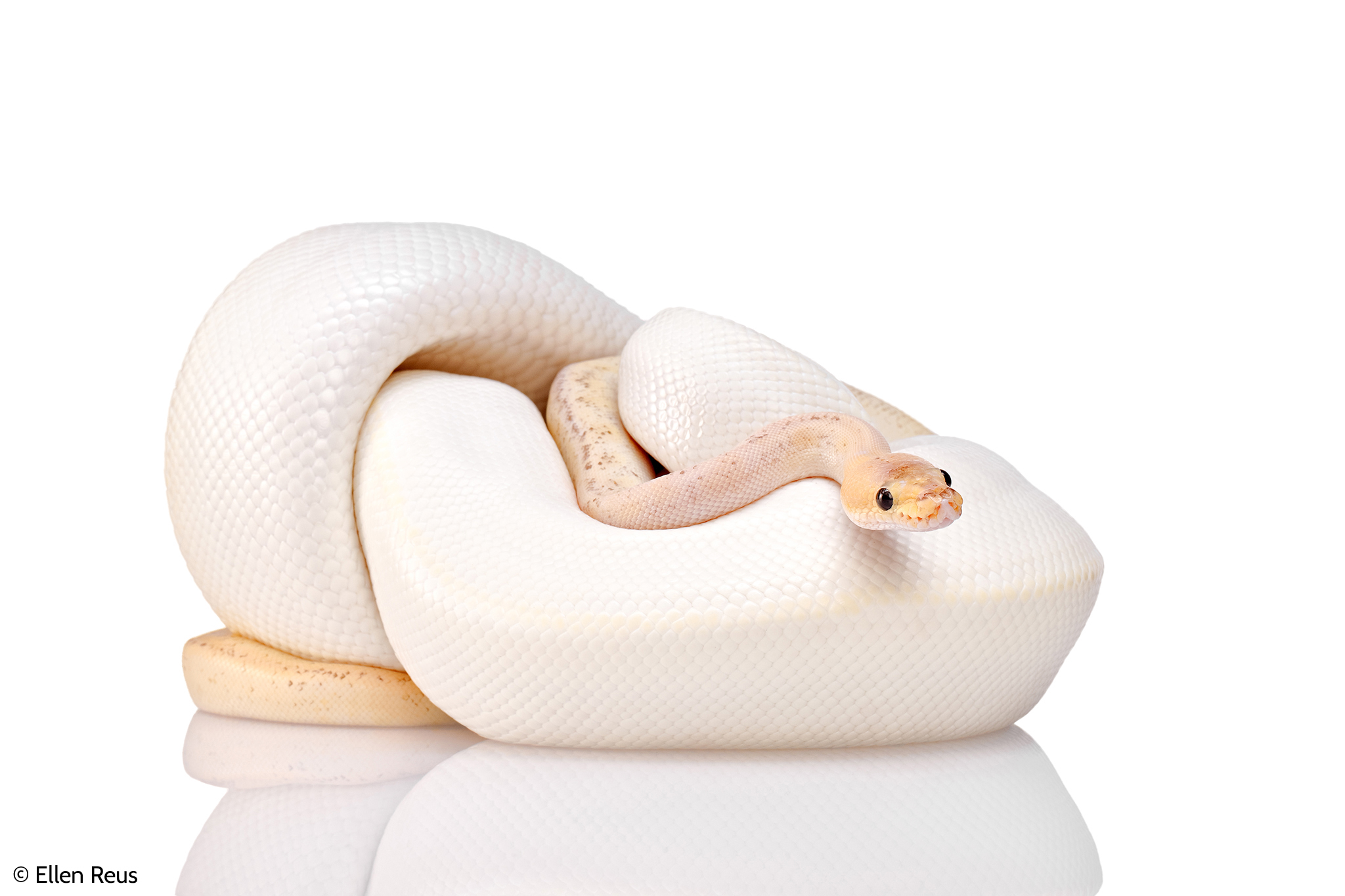
What makes Ellen's winning portfolio particularly distinctive is its subject matter. All three images feature Ball Pythons, and Ellen's mission is clear: to show the world how beautiful and photogenic snakes can be. The images range from a minimalist study of a pure white snake against a white background, to a playful conceptual image featuring a Champagne Yellowbelly morph coiled around a bottle of Moët & Chandon, to a subtly surreal image that challenges the viewer to look twice before realising they're actually looking at two snakes.
In this interview, Ellen shares the careful planning that goes into photographing snakes, her perfectionist approach to post-processing, and the two people who pushed her to pursue photography professionally eighteen years ago.
About Ellen's winning images
Is there a story behind any of your winning images you'd like to share?
I really love photographing snakes, they’re incredibly photogenic! The photo with the champagne bottle is part of a series in which I highlight the snake’s morph (color variation) through the styling of the image. This particular snake is a Ball Python (Python regius) with the Champagne Yellowbelly morph.
The other two photos also feature ball pythons. The “half snake” photo is balanced by the other photo, which actually features two snakes. Both the breeder and I enjoy creating slightly surreal images. With this photo, we hope viewers will first think, “That can’t be right, such a large body with such a tiny head?” before realizing there are actually two snakes: one large snake with its head hidden, and a much smaller one with its tail hidden.
What inspired you to capture these images?
What inspires me most is the snakes themselves. They are fascinating animals, and I want to show people how beautiful and photogenic they are. I also enjoy creating images that stand out from typical snake photos, always making sure the snake is comfortable and never forced.
What was the most challenging part of creating these images?
With all snake photos, you can plan as much as you want, but in the end, it’s the snake that decides whether it wants to cooperate. As a photographer, it’s about carefully observing and quickly responding to small movements. I always choose moments when the snake is relaxed and moving naturally. Sometimes I ask the snake to do something, like hold onto the bottle, but I never force it.
Animal welfare always comes first. I’m lucky that the breeder socializes her snakes very well, so they are usually curious, relaxed, and willing to participate. For the champagne bottle photo, there was an extra challenge: the snake had to hold onto the bottle without moving it. The final image was made from multiple exposures of the bottle, so any shift would have meant starting over. Fortunately, everything worked out perfectly.
Did you know right away that these images were special?
I always review my images during the shoot, and as soon as I saw the "two snakes" photo and the "champagne" photo, I knew I was really happy with the results. The “half snake” photo, however, only revealed its full impact during post-processing.
About Ellen's process
Are your shoots planned or can they be spontaneous moments?
All my snake shoots are planned, if nothing else due to the breeder living far away. Timing also has to take into account factors like feeding (some snakes eat once a week, but most eat even less often) and shedding, since these greatly affect their behavior and appearance.
How do you prepare for a shoot like this?
When planning a conceptual snake shoot, preparation starts more than a month in advance with selecting which snakes will be used. The snakes are fed in advance, since eating often triggers shedding in the following weeks. Ideally, the snakes are photographed just after shedding, when their colors are at their most vibrant and their scales look their best.
What techniques or equipment do you use for images like these?
I use studio strobes with various light modifiers. For the photo with the two snakes, I also used a glass plate to create the reflection.
Do you have a favourite lens or tool you rely on?
Yes, I am completely devoted to my 70–200 mm lens, although for photographing snakes I usually use my macro lens 🙂.
How much post-processing goes into your images?
I’m a perfectionist, so I usually spend quite a lot of time editing my photos, including removing dust and small particles. The champagne bottle photo was especially time-consuming, as I lit different parts of the bottle separately and combined them into the final image.
How do you connect with the pets you photograph to bring out their personalities?
I always let them get used to my studio and to me before I start photographing. They are free to be themselves, and I never make them do anything they don’t want to. I stay calm and patient, and in this way the animals usually feel comfortable and naturally show their personalities.
About Ellen's journey
How did you get started in pet photography?
For me, photographing pets brought together my two greatest passions: animals and photography. Even as a child, I was always taking photos of my cats and other animals. It felt like a natural step to specialize in this field, allowing me to combine my love for animals with my creative work behind the camera.
Have you entered awards or competitions before?
Yes, I enter the International Color Awards every year, occasionally the Spider Awards (a black-and-white photography competition), and last year I participated for the first time in the International Photography Awards (IPA).
What does winning this award mean to you?
It means so much to me! I’m still floating on cloud nine! Winning this award not only recognizes my work and passion, but also allows me to show that even non-furry animals like snakes can be beautifully photographed in a studio. I feel incredibly motivated to keep exploring and sharing this work.
Who or what has influenced your photographic journey the most?
Looking at my professional career, the people who have influenced me the most are without a doubt my father and my sister. They insisted that I should pursue photography professionally. At the time, over eighteen years ago, I didn’t yet feel confident in my own abilities, but they believed I could do it. Thankfully, I listened to them, and now I have the best job I could imagine.
What's one piece of advice you'd give to other pet photographers?
Take your time during your shoots and stay calm and relaxed. Animals easily sense your energy, so if you’re stressed, they will be too, and capturing great photos becomes much harder.
Here are two additional tips I’d like to share: Understand your model and learn about their behavior and what’s important to them. For example, snakes don’t like strong perfumes, which can make them tense and want to leave. Even though snakes don’t have ears, I still talk to them. I believe they can sense my intention and feel the vibrations of my voice. Enjoy photographing your subjects and the process itself.
About Ellen
Do you have any animals of your own? Tell us a bit about them!
Unlike what many people might expect, I don’t have any snakes or other reptiles as pets, but I do have two cats. Sprietje is an Oriental Shorthair and Maze is a Siamese. They are both loving, fun, present, active, intelligent, naughty, and sometimes a handful, and I am madly in love with them. ❤️
Maze has one big drawback: he doesn’t like being photographed. As soon as I pick up my camera, he starts meckering (grumbling). 😂 Luckily, Sprietje doesn’t mind at all, so I can take photos of her freely.
If you could photograph any animal in the world, who (or what!) would it be?
Pfff, that’s a tough question! There are so many amazing animals I’d love to photograph. In terms of snakes, a cobra is definitely high on my wish-list, but I’d also love to photograph big cats. The Arctic wolf in its natural environment has been on my bucket list ever since I was a teenager and first saw the stunning photos taken by Jim Brandenburg.
What's your favourite part about working with animals?
Everything, except for the loose hairs that end up everywhere, especially during shedding season. That’s one big advantage of photographing snakes: no hairs to clean up afterwards! Hahaha. But seriously, I absolutely love how animals can just be themselves. I mostly work with animals that don’t follow commands on request. That doesn’t mean you can’t guide them, but you have to do it on their terms. You need to understand them and figure out what motivates them. Since animals are a true passion of mine alongside photography, this is honestly one of my favourite parts of the job.
What's next for you and your photography?
I hope to continue developing my snake photography. I’ve just started a new fine-art concept, and I’m excited to see where this project takes me.
You can see more of Ellen's incredible work on her Website, Facebook and Instagram.
Join our Mailing List
Want to stay updated with all things IPPA? Get on our list to receive all the inside info!
We hate SPAM. We will never sell your information, for any reason.
